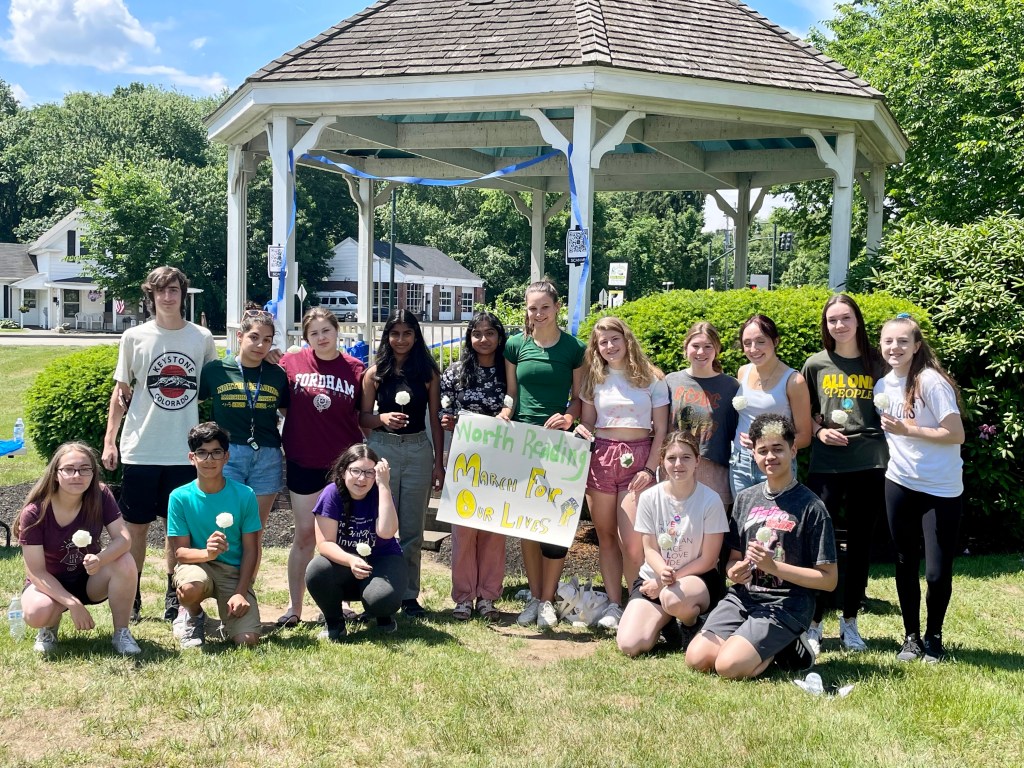
What is social activism? Sit down with officers of the Social Activism Club, past and present, to learn what it means to the students of North Reading High School.
Shivani Srikanth ’22, the founder of the club, says that things changed for her at the beginning of the 2020 school year, her junior year. “I started hearing a lot of concerns from parents in the community through some of my work with North Reading Youth for Anti-racism,” she started. “[These concerns] alerted me to this larger pressing problem, not just in North Reading but…nationally, which is that in [non-diverse] communities you see a lack of integration of minority students.” As the Black Lives Matter movement reached its peak in 2020, she and her friends set out to create the club.
“I first recognized that it might not be my role or my place to be inserting myself into a narrative that’s about Black Americans and their treatment in this country. But something else I noticed was that North Reading had a pressing need to focus on diversity, equity, inclusion, and belonging.” She is grateful to her allies in her journey to start the club, including administrators like Dr. Daly and Mr. Loprete. She was motivated to create a space where people could “seek advice, seek awareness, and seek learnings.”
And so she did. She worked with a few of her classmates, Veronica Stantcheva ’22 and Lily Joyce ’22, to create a club where students could talk about their experiences, issues they cared about, and just have a place for support. They first approached the former vice principal, Mr. Hehn, who was incredibly supportive of the idea. They petitioned with students in their grade and the school committee, and ultimately, the club was formed.
Her purpose prevailed, with important events the club organized including March for Our Lives against gun violence. She says she has learned a lot from this club. “Being involved in the club helped me consider equity in everything that I do…I have this desire to do good and bridge gaps to make positive change.”
Current co-president, Brian Conlon, discussed some of his thoughts about the importance of the Social Activism Club and brought me up to date with some of the work they are doing. A senior at North Reading High School, Brian said he became a strong participating member of the club this year. He had developed new ideas, and he thought the best way to accomplish them was to lead from the front. He states that, “The club gives people a lot of comfort in knowing that there’s a large group of students and officers who want to work hard for people who might be affected by certain issues.”
This year the Social Activism Club is focusing on a few new initiatives. They were able to receive funding with a grant from the Celtics, allowing students in the club to direct efforts towards working with middle schoolers. The club officers believe that presenting role-play scenarios, discussing why they would be an issue, and asking how to address the problem “helps establish knowledge and education for younger kids.” The club is also planning to start debates again, an initiative started by former president Taleen Toby ’23. Brian concluded, saying the club is looking to plan a Culture Day, “[an] amalgamation of a bunch of different cultures and people who come together.”
When asked about the current social climate of our school, America, and on a global scale. Brian notes, “You see how political polarization has kind of influenced the way kids talk to each other…people tend to voice their opinions strongly. A lot of times, those can be hurtful opinions.” In describing North Reading, he said, “There’s a lot of passive aggressiveness and a lot of quiet reclusion. I think people are very cliquey when it comes to their ideologies.” Acknowledging the lack of diversity in our town, Brian says he understands why it can be difficult for people who are different in terms of sexuality and race to feel heard.
As a member of the majority himself, Brian explains that it is extremely important for there to be representation in the governing members of the club, hence the new organization in the club of having nine officers. Currently, Social Activism Club has two co-presidents along with three other senior officers and four juniors. Brian says that this model allows a diversity of opinions and contributions, a crucial aspect in social activism work.
Mahir Mugdho, one of the junior officers, believes this model is extremely effective. He thinks that even though there are so many members in leadership, they are each quite influential. He says the current presidents, Brian and senior Aiden Patel, are both doing a lot to make sure everyone’s voices are heard. With everyone thinking outside the box, Mahir affirms that “just any idea can help us achieve even a small impact.”
As a person of color, Mahir says he has been on the receiving end of discrimination within the high school, one reason why this club remains relevant, despite the progress made since the club’s conception. “People recognize sexism and racism as genuine issues, and they label [offensive comments] as jokes.” This comes from a place of ignorance and immaturity, but also from a lack of education. Right now, officers of the Social Activism Club want to focus on educating themselves and middle school students on a range of social issues.
But how would high school students digest that it isn’t okay to say these harmful things? How is the club trying to handle this? Mahir says, “It’s difficult. And it’s, I mean, the simplest way to answer that would just be to change the culture. But that’s a lot, that’s much more easily said than done.” Largely, he indicates, the club is important because of the disparity between peers. “It helps to make a difference…I’m sure many people here acknowledge the tension that’s in the school. Not everybody here is the closest with each other. And people should join this club if they want to bridge that gap between people.”
When asked to describe the Social Activism Club in one word, Brian Conlon says, “Ambitious.” He follows up, “What [Shivani] did was very admirable. [Now] we have new leadership, new resources, and the continued backing of the administration. We’re trying to test the waters…and see what sticks and hopefully set another precedent for future officers to take over.”
As he looks forward to the upcoming year, Mahir says, “Hopeful.”
Reflecting back on her term as president from 2020-2022, Shivani responds to my question without hesitation. Her word? “Necessary.”
 The Buzz
Leave a comment