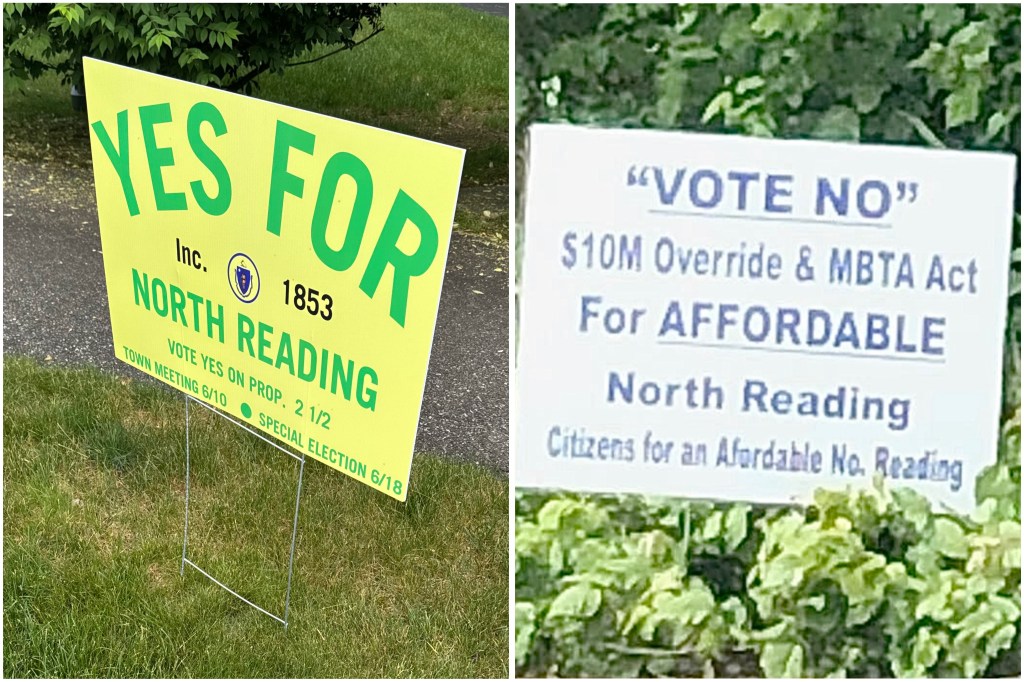
The following transcript is from an interview with Dr. Patrick Daly, Superintendent of Schools in North Reading, recorded prior to the June 18th special election. In light of the town meeting on June 10th and its carry-over onto June 11th, we wanted to learn more about Article 16 and Proposition 2 1/2, including how schools townwide are impacted and how the tax override could potentially work. The Article itself passed with 555 votes for YES and 181 votes for NO after a paper ballot was called.
The following interview was conducted by Sucheta Srikanth.
INTERVIEWER: Can you summarize a bit about what Article 16 is, just in general?
DR. PATRICK DALY, SUPERINTENDENT OF SCHOOLS: So every year we need to have a budget in order to do business. We have a process where we work with the town to figure it out. The school committee has to approve that, we have a budget hearing. So it’s a process that starts way back in the fall and then is approved at the town meeting.
On the school side, we look at what programs we need for level services. We want to offer students the same experience from one year to the next. But as we know, costs are going in one direction. It costs more to heat the building, costs more to provide transportation, it costs more for salaries, it costs more for paper. Everything is going up.
Then the town looks at all its revenue sources to figure out what they can give to the schools to support them. We’ve been able to figure out a way to make it work and to make certain cuts or adjustments over the last few years in order to arrive at a balanced budget and not go into town meeting with a deficit and not have to make a lot of cuts. We do not want to give out pink slips and tell a teacher or a paraprofessional, I’m sorry you’re not going to have a job next year.
This year we were 1.2 million dollars short at the end of the day. So we had to either cut all these positions and other programs or consider a way to try to increase the money that’s available to the town.
INTERVIEWER: How is that decided?
DALY: We have a financial planning team which is made up of myself, Mr. Connelly, who’s the assistant superintendent for finance and operations, the town administrator, the town finance director, and then two members of the select board, two members of the school committee, and two members of the finance committee come together.
This is a great proactive thing we do in North Reading to talk about how we can come up with a financial plan. We decided that it was time to discuss an override and we decided to do a town-wide override that would include elements such as bridge repairs, elements that are municipal positions, town positions, and then also school positions. So all of this is the operating budget.
Separate and distinct from that is capital improvements, building improvements, you know, new roof, new boiler, new trucks, etc. We’re talking about just our operating budget, what it takes to pay salaries, bills, supplies and materials. Our job is to let people know that without additional revenues, these services might go away.
INTERVIEWER: So why do you think people wouldn’t want to vote in favor of Article 16?
DALY: I think in general, everyone supports the schools and everyone supports the town and the projects. The challenge for North Reading is that the taxpayer owns the burden. We don’t have a dual tax rate for commercial rate and we don’t have a lot of commercial or industry so a lot of the burden falls to the homeowners.
So you do hear from some people saying why don’t we charge Walmart more money for their tax rate and not the same as a resident? The downside is if you charge more money to the commercial properties and then they leave, you know, a boarded up Walmart is paying you zero and that’s not good.
You can’t say, I don’t want the character of town to change. I don’t want condos going in. I don’t want this or that, and then not have change. You can’t have that. Things are going to change, because we can’t afford to keep them the way they are.
North Reading has limited options. For the average homeowner, we’re talking, $1,700 over three years. And I think for senior citizens, their income is fixed. That’s where it gets really challenging.
INTERVIEWER: How are you attempting to connect with senior citizens?
DALY: Mr. Gilleberto and I, along with Mr. Connelly, Ms. Galvin, took some meetings, and held several webinars just to give people information. But we also specifically went to the senior center, we went into Martin’s Landing, an over fifty-five community, to really build some relationships so they can understand our situation.
The first thing people might say is the schools are just not being financially responsible. And what we really tried to make people understand is this is what kids need. This isn’t about being greedy. We’re below the state average in administrators. Sure, our classes are good right now, they’re favorable. If we want to maintain that, there’s going to be a cost. If we don’t do anything now, they’re going to get much higher.
In the next three years we’re talking about potential cuts to a lot of different programs across the board. And so it would be irresponsible of us not to let people know that in as far advance as possible. Our goal is through this override that we don’t need to talk about this year in, year out.
INTERVIEWER: How much is the override asking for now?
DALY: So we came in with $10 million over three years. This is opposed to, if just the schools asked for $300,000 just for this year. And the next year, we’ll be back for another $300,000.That might have been more favorable because it’s a smaller impact, but it would have been every single year. But we’re trying to build trust over time. Ourstrategy was, let’s go all in and show you what it looks like over the next three years.
INTERVIEWER: By roping in these municipal fixes, do you think that you would have kind of gotten more support from senior citizens?
DALY: So I think the goal was to make the package attractive to everyone because everyone supports education. But obviously, if you’ve got kids in the schools, you’re more committed to it. So I think part of the strategy was we want to be very transparent that the school committee and the schools support the needs for seniors as well. So having things that touch every citizen like firefighters, town positions, the bridge projects, and all those things. We wanted to make sure that everyone could see the value.
Less than 50% of the override is directly school related. But there seems to be a sentiment that the override was for the schools. That’s not really the case. It was for everybody.
INTERVIEWER: What are the consequences if the override doesn’t pass?
DALY: I think if it doesn’t pass, we would then have to figure out what we’re doing next, because we will be right back next year. We will not just be saying we accept these cuts.
So we would be right back next year outlining exactly what those cuts would be. And coming up with a different strategy to try to get an override. There’s nothing that we’re talking about that would be tolerable.
INTERVIEWER: To the extent of which you can share, what would some of the cuts be?
DALY: So if you just look at the numbers, we had to cut 15 this year, you can easily say there’s another 15, maybe more next year, and then another 15 the year after. So 45 to 50 positions over three years. And then we sort of identified possible areas, but it’s too soon.
We did identify a lot of cuts across areas, but computer science, digital learning, tech engineering, arts, performing arts, administration, I mean, basically everything, facility, custodial, because when you’re talking $2 million plus in cuts, there’s a lot. Every year our administrative team goes through having to make those cuts.
INTERVIEWER: Can you speak a little bit about potential spending?
DALY: What happens next Tuesday, the ballot allows us to spend up to $10 million. We’re going to do a little bit each year. But what it does is it permanently changes the trajectory. So every year, you can only raise taxes by 2.5%. This would put it on a new track. At the end of those three years, you can only do 2.5%, but you’re now on this new trajectory because of the override. And so the taxes would be higher than if there wasn’t an override. That is the permanent change to the base. But each year the funds need to be appropriated by town meeting.
INTERVIEWER: With Article 16 in particular, what were the general reactions at the town meeting?
DALY: It’s very typical to have questions, answers, motions. There’s a lot of emotions. I think you’ve now got word of mouth, you’ve got social media, you’ve got people talking on Facebook. So people bring a lot to the meeting.
I think there’s some people that were firmly against this because there was just sort of a mentality that it’s unaffordable, and I’ve seen the NO signs around town that say it’s all about affordability.
I think on the other side, the YES folks want to support our schools. And yes, it’s going to cost more. No one wants to pay it.
The next step is figuring out how to change the tax base in town and find new growth areas. For years, we had new growth money coming from new building projects, but that’s no longer the case. That’s plateaued. So unless we find new revenue sources in town, we’re going to be in this scenario for many, many years.
INTERVIEWER: What do you wish to tell others before voting?
DALY: As superintendent, I can’t take a side, but we can encourage people to engage in their civic responsibilities. But obviously I would support anything that’s going to help our kids and our staff and our schools and be reasonable and try to work with anyone in town who’s not able to afford it to understand why this is needed and to try to work on different solutions so that it is affordable moving forward. But I’m always welcoming questions and we received plenty of them.
So it’s very important that people continue to vote because you need to have a majority. The town meeting decides how to spend the money and the election decides what we have to spend. So if the election doesn’t happen, we can’t do anything other than the first budget, which is the cuts. And if the election doesn’t pass, it’s sort of back to the drawing board.
 The Buzz
Leave a comment